“We can’t sell,” my mother would say over and over again, referring to our family of four—me, my sister, our father, and herself. I don’t know where this belief came from, but when I think about it, it probably has something to do with our idea of what a salesperson is: an arrogant, cocky, no-nonsense guy, a guy who stops you on the street and aggressively tries to push something you don’t need. And as a good kid, I seemed to take that for granted and completely avoided even thinking about sales consciously for many years. Which is funny, because if you have your own business, your main job is to sell, otherwise you can’t market your products or services at all. And my first job was to start my own business 😉
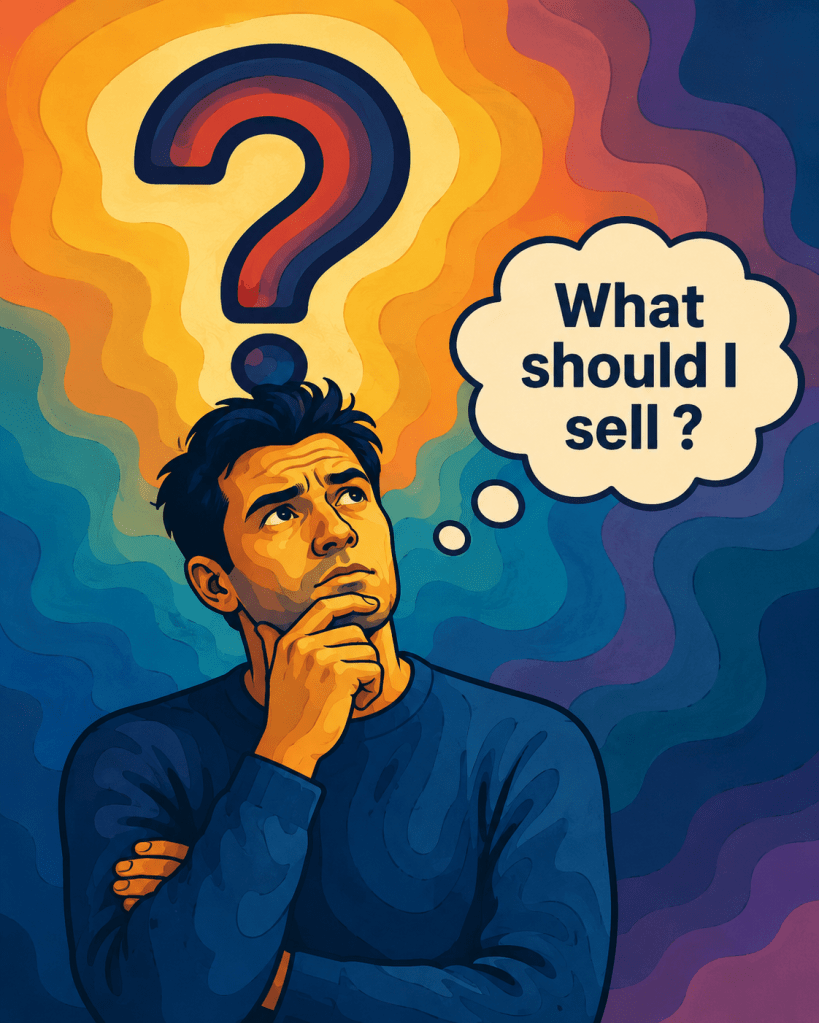
Recognizing my own limiting beliefs about sales wasn’t that easy. From “I can’t sell,” I went to “I don’t know what to sell”. And here, of course, I discovered many negative thoughts that affected not so much what, but mostly how I sold, because the same idea that I had to be aggressive, violate other people’s boundaries and expose myself publicly, was born in my mind, so I felt a deep disgust at even the thought of starting to do something like that. A trap is a trap – it just changed the story that kept me inside. And at the same time, I expected my clients to somehow magically appear and find me. Which actually happened, otherwise I wouldn’t have survived, and my business still slowly started to develop.
At one point, I “discovered” Kiyosaki’s “The Cashflow Quadrant” concept, which gave me an important structural framework for making money as a whole. It simply opened my eyes to the fact that I did not own a business system, but simply owned my profession, in the form of a small business. It was a disappointing “discovery”, but it was true. So I focused on building business systems and getting good at it. Really good at my new job of building or fixing business systems for other people, keeping my place in the small business quadrant. I guess I didn’t quite get it 🙂
Because every business system has to sell something and needs at least one structured product or service to function as a business. The system itself is a machine for attracting customers and delivering products and services, which is now becoming even more automated with artificial intelligence, but without a product or service that provides real value to the customers, such a machine has no reason to exist.
That’s where I found all these online business gurus with their overpriced courses that basically teach you the same thing: to copy other people’s products and services. And do you know why? It’s simple – they already have a market, so the risk is lower than building your own product from scratch. But this has been a dealbreaker for me, because I value innovation and improvement, so I can’t just become an imitator and be happy, even if such a business makes me money. Sorry, maybe I’m crazy, but that’s me.
So finding your way in product or service design can be lonely, but using external help here can be really distracting in your path, because there is a tendency in our overcrowded with “teachings” world: no one cares about who you are and what you want to express. Most “helpers” position themselevs as a teachers and start selling you their own way to make money, no matter that one size does not fit all – this is what they have to sell, so the deal is “my way or go away”. I chose the latter, of course…
The old school says when you have a problem and can not find solution for it at the end you make your own solution for this kind of problems and can convert it to your own business. There is lot of examples about this, starting with Sara Blakely with Spanx, via Drew Houston with Dropbox and Tobias Lütke with Shopify. And I strongly believe this way is one of the most reliable reasons to start your business.
But the real question is: what happens when you want to start something of your own, you have a lot of experience, like most corporate employees, but you just don’t know what to sell? Having been in this position many times – yes, I’ve started different things in my life and I’m currently on my next “new” thing – I’ve found that it can be extremely difficult for people with many abilities to navigate. And the reason is not a lack of skills or ideas, but the opposite – too many options. Which is a real and serious problem because it leads to confusion – our brain can easily choose if we have up to 3 options, because in that case it’s just comparing. But if we have 30 or 300, we have a real problem. And we need a method to solve this and get clarity.
Unlike the gurus, I don’t think there is one working method that is valid for all people with this problem. Rather, I think that each person has their own way and their own values that determine what they think they could sell and what they couldn’t charge money for. Here we can explore the idea that behind these beliefs there may be quite a few fake limitations, behind which financial well-being may be hidden, and the most typical case that I can think of is the thought that if something is given to me easily, then I cannot ask for money for it because it is somehow not fair. Which in turn comes from the belief that the work has to be difficult in order to deserve to be paid. And this is just one of the many possible ways in which our unconsciousness sabotages us.
One way that comes to mind is to simply make a two-column list on a piece of paper. In the left column, I write down the things that I feel comfortable getting paid for, and in the right column, I write down the things that I can’t ask for money for. I just write it down – the important thing is to write it down, not just think about it. And then, for example, in the morning when I wake up or at night before I go to sleep, I reflect on that list. You’d be surprised at the unexpected insights that this simple exercise can bring you.
So, back to the idea of too many options. When you feel like you have too many options and you don’t know how to choose, what works is to start setting limits for yourself. Limits that make sense to you and can narrow down the options to a relatively small number of relevant ideas so that you can choose just one to try. That’s right – just one and try it. Just make it happen – create a prototype of the product or service if you want to be completely honest with your customers, or at least create a sales page and start selling what you’re thinking of creating to see if anyone would even want to buy it.
And while it seems a bit easier for products, it can be more difficult with services, due to their intangible nature, as the service is most often provided in direct interaction with the customer. However, that is where the incredible opportunity for direct feedback from the customer himself lies. To decide what service to start providing, I would suggest the same exercise as above – make a list with two columns on a piece of paper. In the left column, write down a skill that you have and are willing to get paid for – for example, writing blog articles on a certain topic. In the right column, you can write down skills that you have but don’t want to make money from for some reason. Why is this right column important to have? If you’re like me, you have different skills and people who know you value some of them, and you don’t want to provide them as a service, this list will help you not to stumble in that direction simply because others expect it from you, and you don’t really want to do it 😉
The next step is straightforward – you set constraints so that you can narrow down the list of options to a small enough number to choose from. And when I say constraints, I mean things like… I’m not interested in these kinds of clients, I’d get bored of this job very quickly, I should be on social media for this, but I don’t want to, etc.
The key to your new business lies somewhere in the things you’re good at and want to do, but are also willing to get paid for. If you want to do them but can’t ask for money for them, there are two ways – either you leave that thing for the next stage and start something else, or you contact a therapist to explore what exactly is preventing you from getting paid for that thing.
If you think about these things, there is a real chance that you will discover a potential new or additional source of income for yourself and answer the question “what to monetize”, considering which specific skill you can and want to use to make money. This is also your solution to the problem of “I don’t know what to sell”.
Your next step will be “How to Sell” and it is all about creating the right sales process for you, but we will cover that next time.
Discover more from Plutoncho
Subscribe to get the latest posts sent to your email.

