


It is simply an indicator of how much money you dare to ask for what you are offering. I’ll explain.
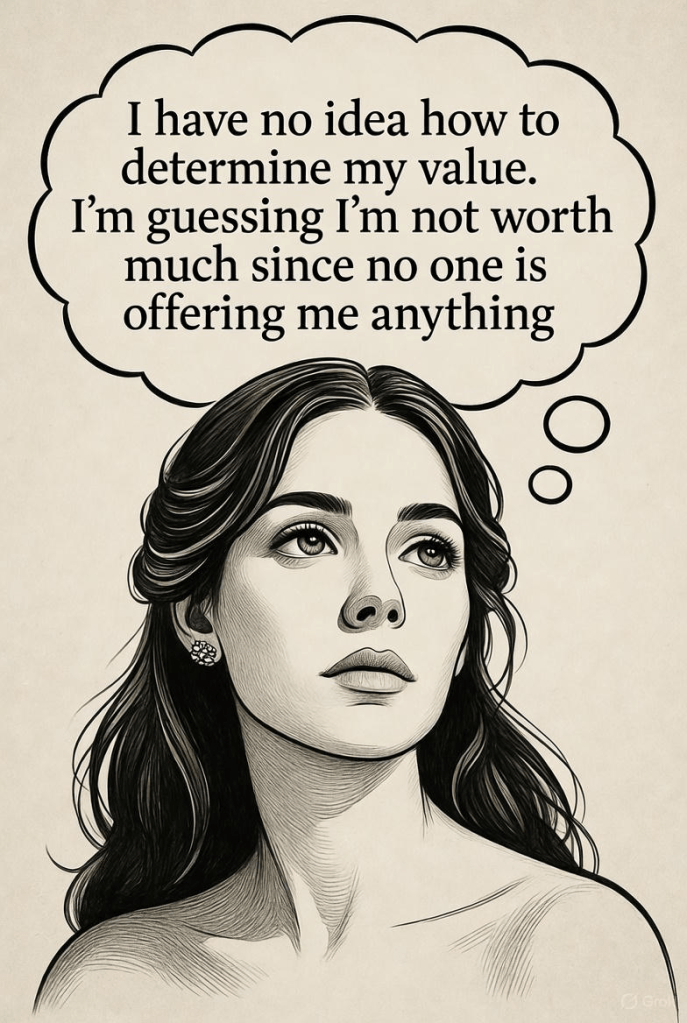
Yesterday I was talking to a friend and during the conversation I noticed that she had suppressed her resentment towards people who didn’t pay her enough, in her opinion, but she blamed them for it because she perceived the price they were paying her as a recognition of her value. I also asked a question that made it clear to me that she actually linked her own value as a professional to the amount of money that clients paid her in her profession. And she seemed to feel undervalued on a regular basis.
This was a little strange to me because she is really good at her job as a helping professional and is certainly recognized and respected for what she does by most of her clients.
But then I remembered that she often asked me about her prices – what I thought, whether she would raise them, and my feeling when I heard such a question was always some kind of confusion that I had not paid attention to before, but now my curiosity led me there.
What I’ve discovered for myself is that if someone asks me as a client about their price, I’m not just feeling little bit confused, but in my eyes they look uncertain. And I feel it like they make me do a hard mental work for them for free: they are asking me to imagine what the fair for me price of their services is, based on their non-existent basic price tag which does not allow me to just compare it to my unconcious standard.
And I say it’s hard mental work because our usual behavior as buyers is different: when something interests us we always have a semi-automatic perception of the fairness of it’s price that is activated when we see it. I say semi-automatic because it’s actually mostly an unconscious comparison of that price with something that we probably don’t consciously know. Behavioral economics calls it mental accounting, and in short, it’s the idea that we treat money differently depending on its source and create mental buckets for it, like grocery money, vacation money, etc.
So what I’m saying is that if you ask your customers to determine a fair price for your services, you’re loading them with a huge amount of useless mental work, because they have to figure out which mental bucket that price falls into for them and compare it to something that seems solid enough to them to decide whether it’s fair or not. That requires a lot of abstract thinking, and if you expect them to have intuition based on their own abstraction, then forget about it. Also, most people don’t realize how this whole process works, and even if they wanted to, they don’t have a reliable method by which they could easily assess and tell you what a fair price for these services would be for them. And last but not least: because buyer behavior is primarily emotionally driven, not rational.
Finally that’s your job, as a provider: to determine the price, based on your own research, assumptions, and perception of the value you provide. Even based on your own logic, if you want (knowing that clients buy mostly emotionally, but it is your choice). Then you put the price tag on the shelf as stimulus and just watch the clients’ reactions. This is the easiest and simplest way, just because when customers see your pricing alongside your product or service, that perception of whether the price is fair or not is automatically triggered. So you have to learn from people’s reactions to the incentive you’re giving them, rather than pushing them to work for you, which they’re sure to perceive as discomfort.
And if we go back to my friend, it seems like she has some inner work to do first, because she’s unconsciously trying to compare her self-worth to the price she’s getting from her customers. But what I thought was that it works the other way around: she sets the price based on her self-worth, and then the market tells her whether it’s acceptable or not. Because yes, in helping professions, you set your own price, based on your own judgment of your own worth. So if you want to raise your price, you have to change your own perception of your own worth first. It’s that simple 🙂
Because value means different things to different people and there are aspects that you can’t even imagine as a provider until you see the recurring pattern with your customers. For example, they might buy because your studio is closest place to their home or because they voted negatively toward their usual provider. Which is not your typical way of thinking as a provider of anything, focused on the “real value” of your services.
Discover more from Plutoncho
Subscribe to get the latest posts sent to your email.
 Plutoncho